What the water permits
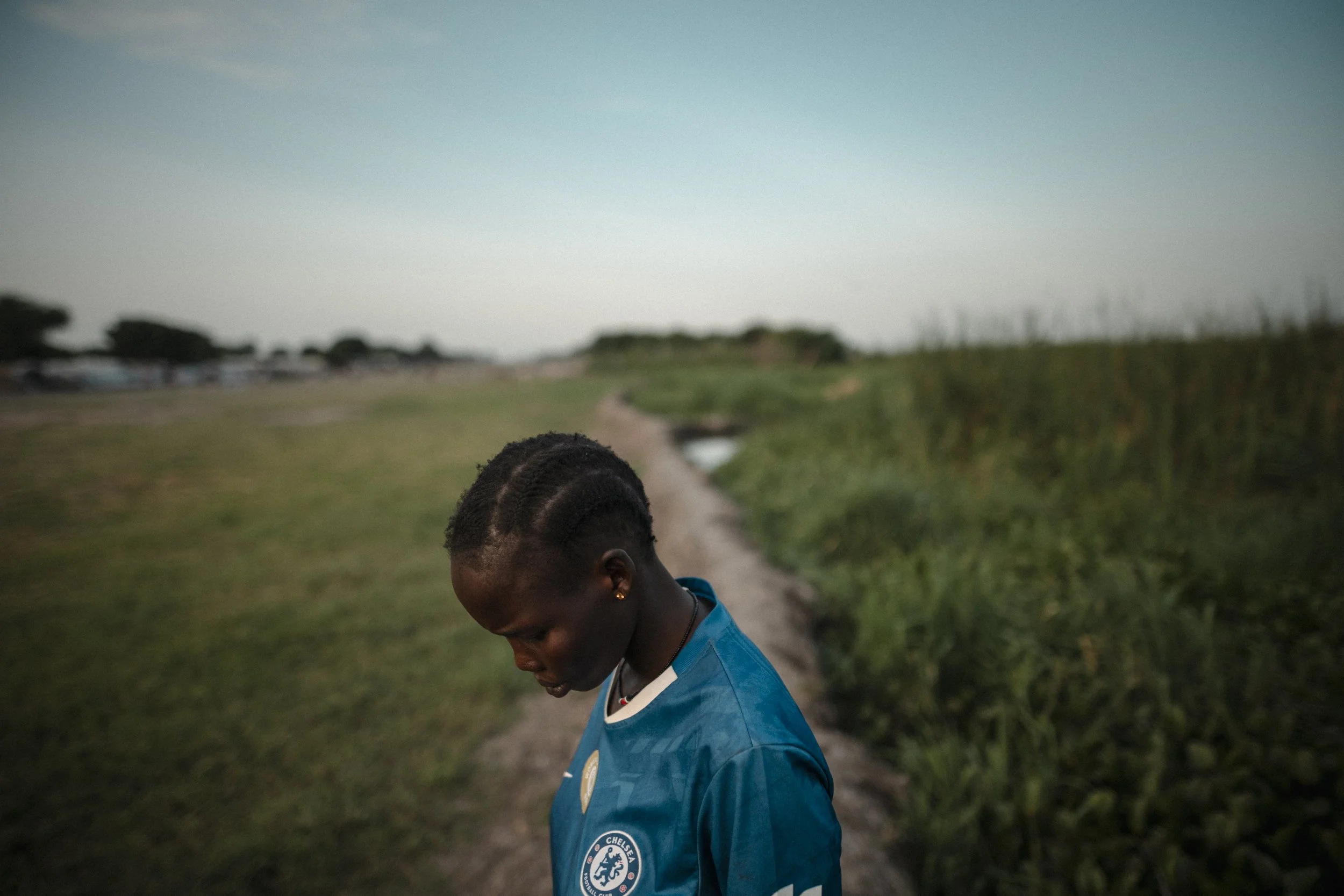
Nyaluak Deng Nger stands on a dyke in Paguir. She lives there with her mother and siblings so the children can attend school, while her father remains where he can find wood and make charcoal.
Paguir and Old Fangak, Jonglei State, South Sudan. To get to Paguir, you first take a plane to Rumbek. To get on the plane, you go through the airport. To go through the airport, you need the stamps, and naturally the papers for the stamps to go on. Multiple copies of them.
We had nearly completed the sequence when the Rumbek airstrip was declared too wet to receive us. We flew to Rubkona, near Bentiu in Unity State, instead, continued by helicopter and walked the last stretch to the compound. Travel here depends less on distance than on what the ground, or the water occupying it, permits that day.
Lunch was fish, very crisp and tasty. A colleague presented it with the promise that ‘maybe tomorrow we will get you fresh fish.’ There would be a great deal of fish. The floods, people said, had killed the cattle and the goats. Even the chickens were few in number. There was much land left to cultivate, and there were no beans in the market.
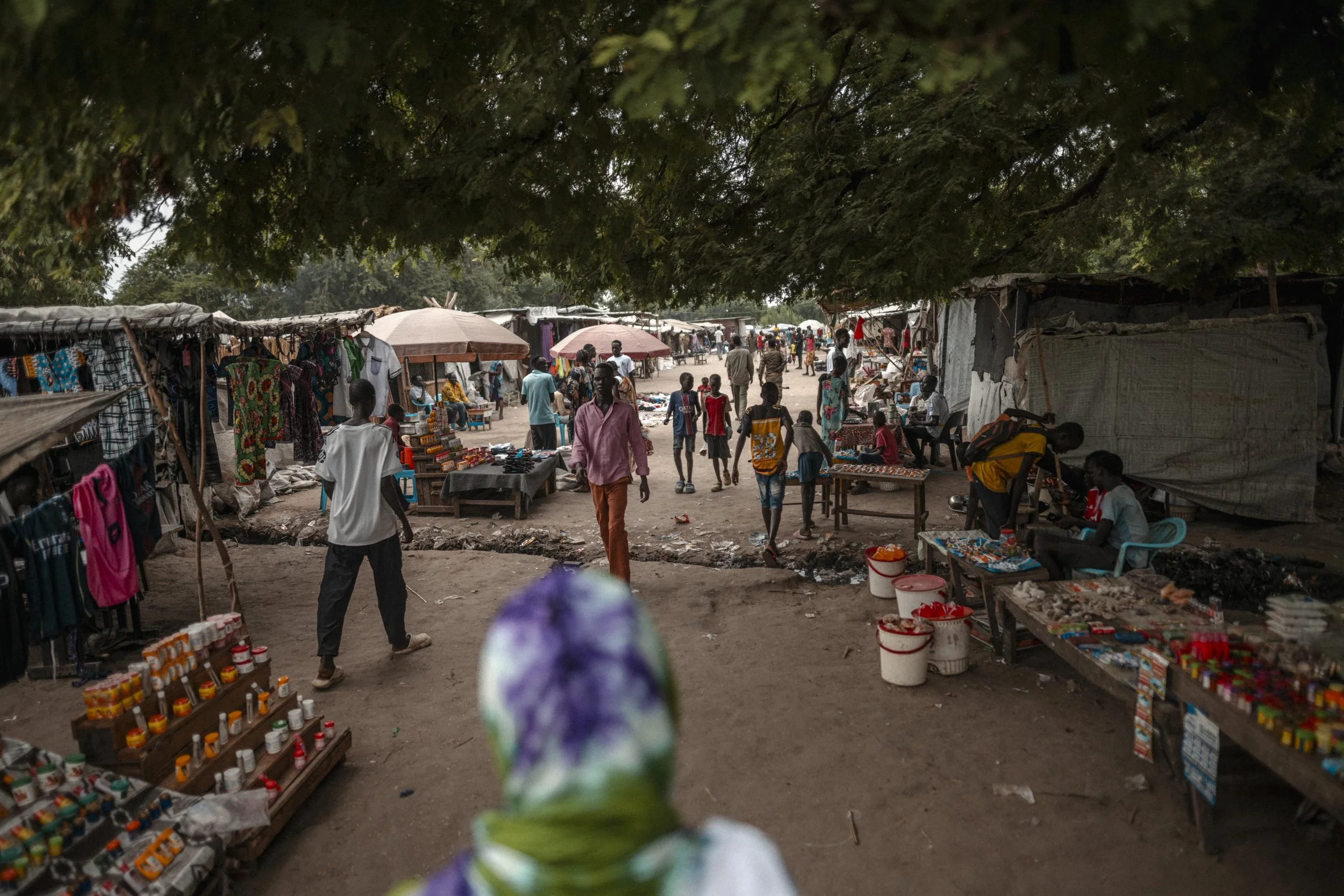
Paguir market occupies some of the area’s surviving high ground. The settlement has grown as flooding and conflict displaced families from surrounding communities.
Paguir sits on surviving high ground in the Sudd. It has absorbed people flooded out of Old Fangak and other settlements, families uprooted by conflict, and the NGO offices that followed them. The airstrip is one of the few practical links to the rest of the country. By boat, the journey to the capital, Juba, could take weeks, if there is fuel.
Electricity followed the sun. On cloudy days it would be gone by five, and the internet with it. The nearest mobile-phone tower, in Old Fangak, also ran on solar power. On a good day, its signal reached Paguir. Mostly it did not. A generator might bring the compound’s electricity and internet back for an hour or two. Darkness was plentiful, except for a battery lamp strapped to a tree whose motion sensor was extremely efficient at destroying your night vision.
The days approached forty degrees. The tukul stored the heat and returned it at night. My first morning began at ten past six when a chicken jumped on me. The chicken, apparently unaware of the reported poultry losses, was in excellent spirits.
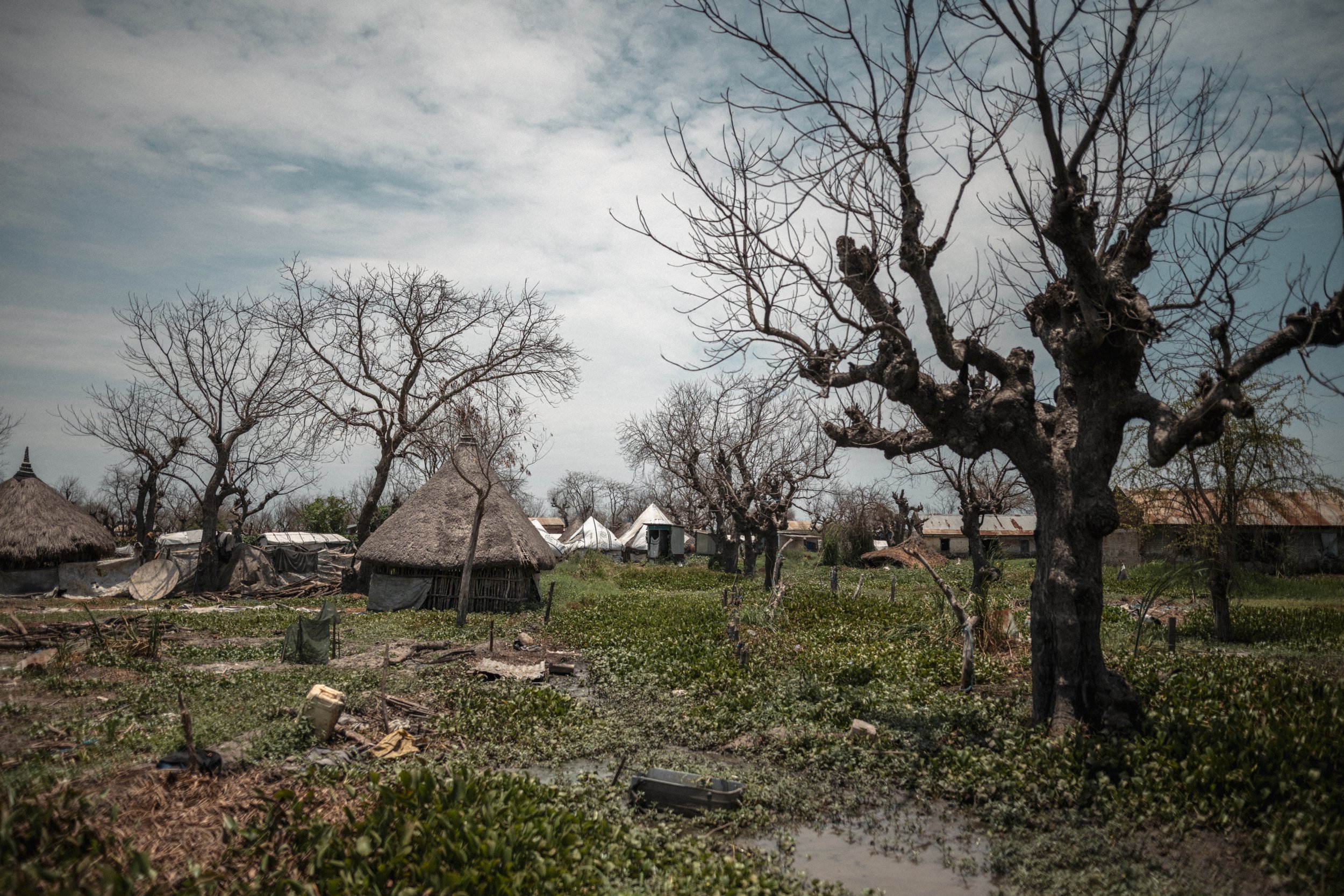
Homes in Old Fangak stand among floodwater and water hyacinth. The dyke protecting the town failed a year before this photograph was taken, displacing residents towards Paguir, Toch and other remaining high ground.
Nobody described the flood as an event. It was a sequence: water in 2016, much worse water from 2020, the great displacement of 2021, and then no retreat. What remains habitable is held by dykes built by hand. In 2025 the one protecting Old Fangak gave way.
Simon Bap Yak, the head chief in Paguir, told us what he could still offer a family arriving with nothing: security, a small plot for a tukul, and a fair place in the queue when assistance came. Once he could also have offered cattle, or sorghum. Of his own herd, one castrated bull remained.
What the water took, the water partly gives back, in a poorer currency. People fish, though nets are scarce. They pull up water lily bulbs and eat them. They cut reeds for roofing, and burn whatever timber they can find into charcoal.
The flood also grows its own plants. Where the water stands still it is carpeted in water hyacinth so thick it reads as lawn, with tukul roofs and the bare crowns of drowned trees rising out of it. A small bird, called kerkademtual here and African jacana on Wikipedia, walks across the top of it on absurdly long toes, treading the leaves as if they were ground.
School is the clearest measure of the new geography. Some pupils wade or swim, holding their books above their heads or sealed in plastic with a dry set of clothes. Others wait for a passing canoe. There is no school canoe. Miss the one that passes and you have missed school.
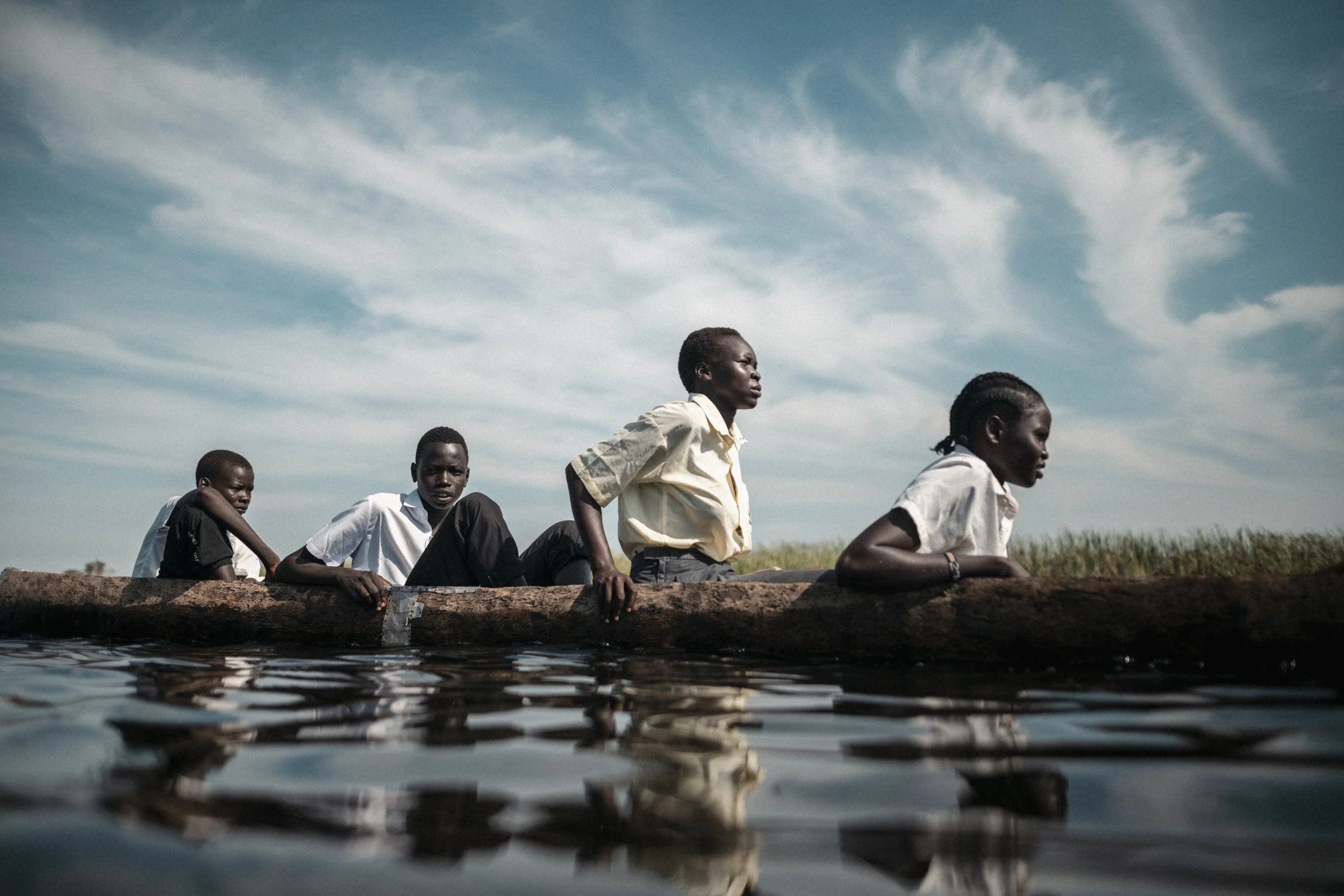
Pupils travel by canoe to school. Flooding has turned routes once crossed on foot into waterways; without a place in a canoe, children may have to wade, swim or miss class.
Nyaluak Deng Nger came to Paguir as a child, when her family brought a sick sibling for treatment. Her mother, Nyadak Muon Nhial, saw a school and decided the children would stay. In 2016, Nyaluak could walk alone across dry land to the settlement where her father, Deng Nger Wuor, lived. The same journey now takes seven or eight hours by local canoe, if someone can be found to pole it.
On 31 August we went to see him: a speedboat, then roughly four hours in a canoe. He had gone to another village. We waited, watching the daylight go. Eventually a messenger came: the old man was coming. He spoke about growing old with no cattle and no field, and about education as the one thing he could still hand down.
On 1 September we took the speedboat to Old Fangak, a year and a day after its dyke failed. Buildings stood in water. The school was under it. The old main road was now the only raised strip where anyone could build a shelter, so people had. There were other ruins too: in May 2025 helicopter gunships had bombed the MSF hospital and fired on the town. A drone later hit the market.
That evening a colleague explained how names here record the circumstances of a birth. The mother of the family we had followed carries a name meaning conflict, because she was born into one. Gatkek, he said, can be connected to a dyke. Nyapini is a girl born in the flood season, when the water comes.
People were less inclined to give that name now, he added.
There was already too much water.
A man pushes a canoe through shallow floodwater after dark on the return journey to Paguir.
See more photographs from Fangak County in my series Here, there used to be land, photographed in 2024 and 2026.