A photograph of wartime education wins News Photo of the Year
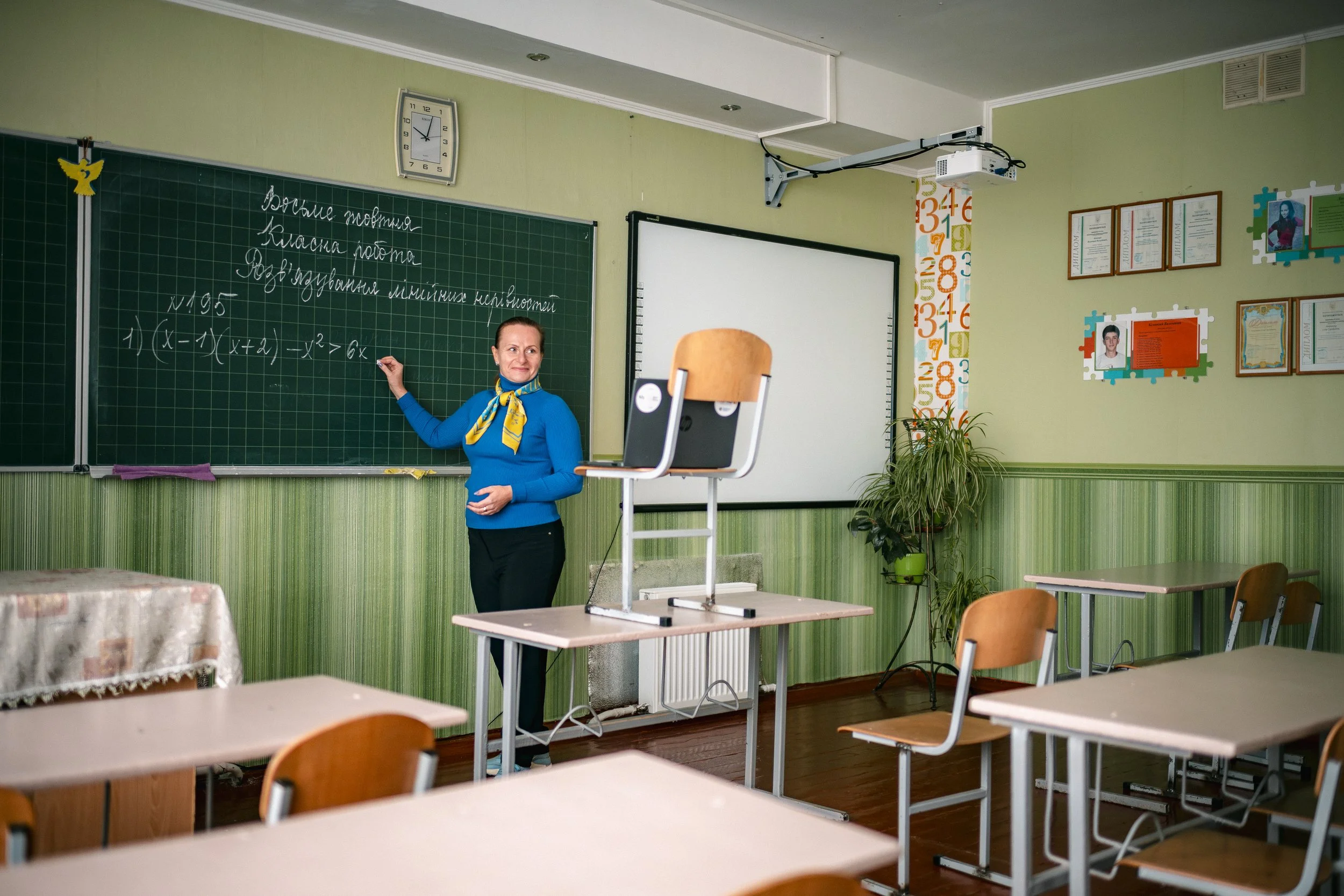
‘If we talk about this month, this is a completely normal day,’ says mathematics teacher Olena Loboda. Because of the morning’s air-raid alert she is teaching an empty classroom over a laptop. Chernihiv, Ukraine, October 2025.
A completely normal day
We had gone to School No. 2 in Chernihiv to photograph children. That was the plan, and it was a reasonable one: Finn Church Aid supports the school, the autumn term was under way, and a story about education in wartime usually needs pupils in it.
There were none. An air-raid alert had sounded before the first lesson, and in Ukraine that arithmetic is simple: an alert before school means a day of remote teaching. Teachers follow the Telegram channels to work out what is coming — a missile is always dangerous, a drone is mostly a nuisance, though nobody uses the word only when there are children in the building. If pupils are already on the premises when the sirens go, they are taken down to the shelter, where there are desks and chalkboards and the lesson carries on underground. That morning they simply stayed home.
So the school was quiet, and I had a camera and no story. I asked the mathematics teacher, Olena Loboda, what it was actually like to teach this way, and whether I could follow her for a while. She opened her laptop, put it on a chair at roughly the height of her face, and started the lesson.
It looked exactly like a mathematics lesson, except that the room was empty and she was speaking to a chair. Some pupils have a good signal, some almost none. For those who drop out, she shares the materials afterwards and helps them catch up.
When asked whether the day was unusual, she replied: ‘If you take this month, this is a completely normal day.’
What normal looks like
The photograph is one frame from that morning, and not the one I would have predicted going in. Chernihiv sits close to the borders with Belarus and Russia and was besieged in the first weeks of the full-scale invasion. Its schools had already been through the disruption and remote learning of the Covid pandemic when the invasion began. Since then, they have spent four academic years learning to work around a different set of interruptions.
Russian strikes on the grid mean the power goes. The school has FCA-supplied charging stations, thermos flasks and lanterns so that teachers can charge a phone, make tea and keep working. When in-person classes coincide with a power cut, they are lit by lantern. When the heating fails, children sit at their desks in their coats. When teaching moves online, satellite internet keeps the school’s end of the line open — the weak link is usually at home.
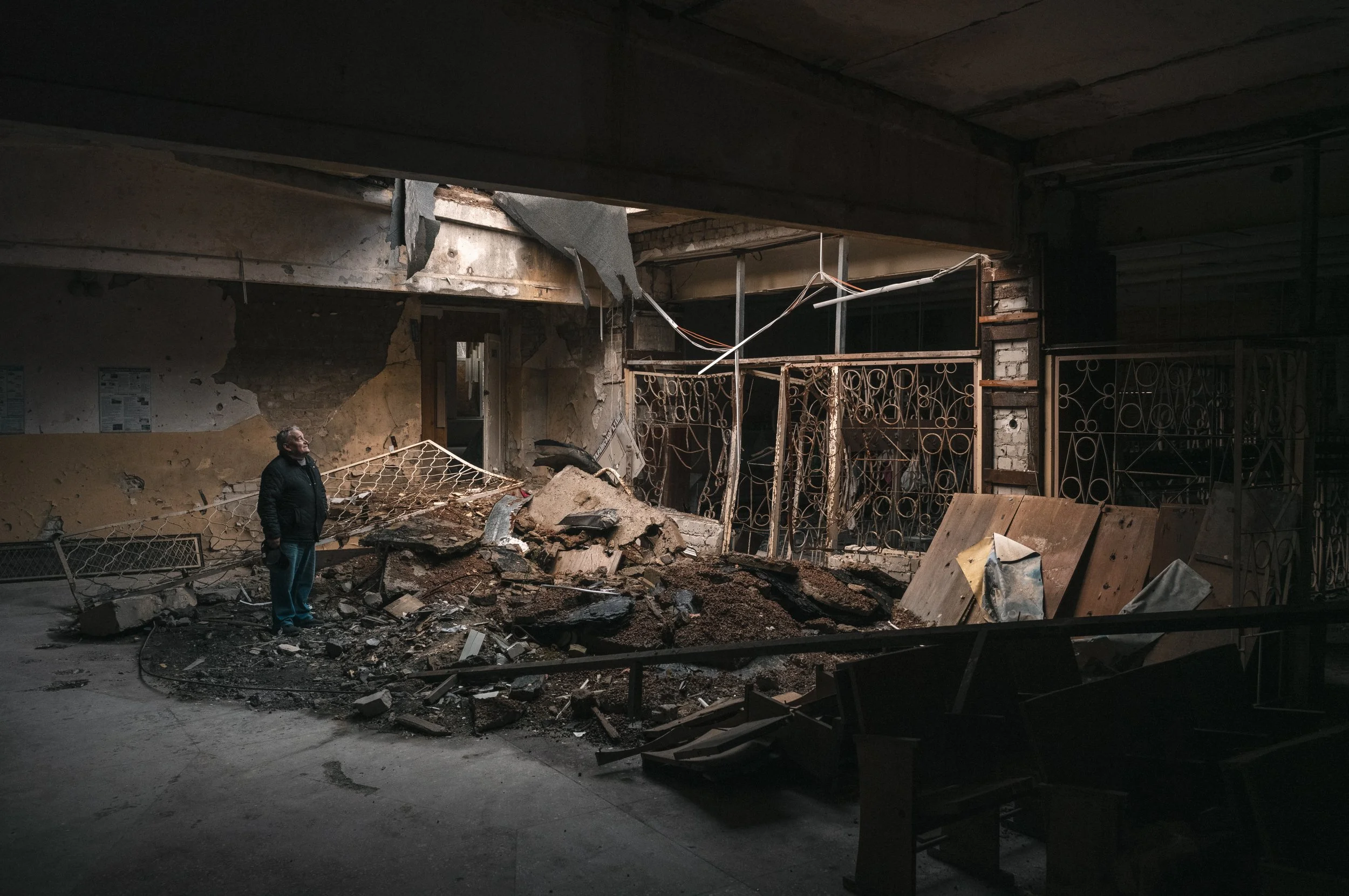
Oleksander Grianyk, principal of Kharkiv School Number 62, stands in the damaged lobby, recounting the night of April 8, 2022, when the school in Piatyhatky was heavily bombed. The photograph is from Classrooms Below Ground, a series on how Ukrainian schools continue teaching through war.
This has become ordinary in Ukraine, which is rather the point. Going into the fourth academic year of the full-scale war, only about a third of Ukrainian schoolchildren were learning fully in person; another third were in some form of hybrid arrangement, and a third entirely online, according to UNICEF. More than 1,600 schools have been damaged or destroyed according to UN-verified figures, and the real number is certainly higher. Assessments put average learning loss at around two years in some subjects.
I have photographed extensively in Ukraine since spring 2022, and one thing has changed: what ‘the war’ looks like up close. Early on, it was displacement and uncertainty. Now it is routine — a heavy, expensive, occasionally lethal routine that people have organised their lives around. In some ways it is harder to photograph than destruction, and I think it matters more.
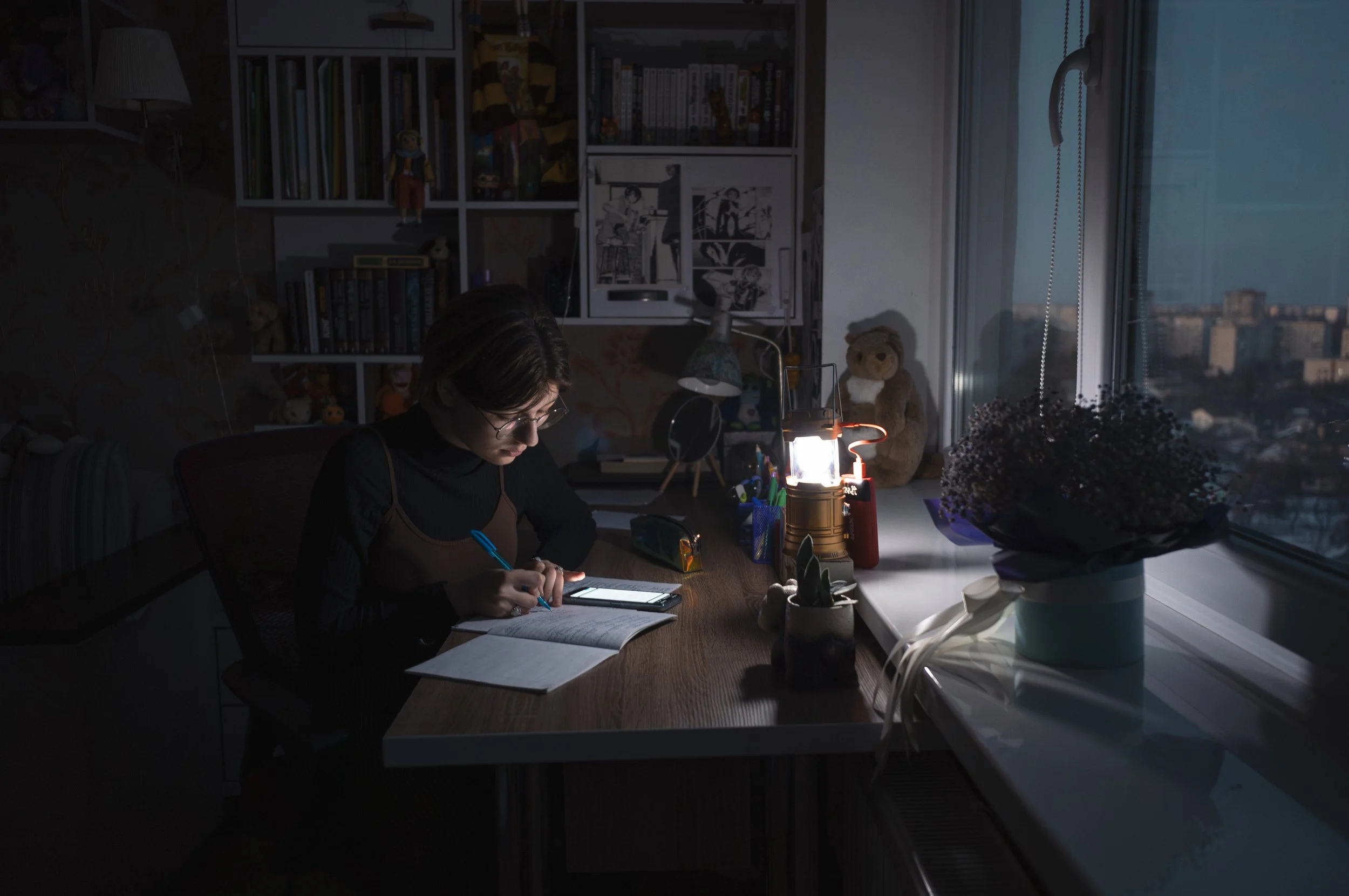
Fifteen-year-old Karina Bykova, residing in a high-rise in Chernihiv, Northern Ukraine, faces daily power outages, leading to darkness and cold at home, with the water supply often cut off. ‘After school, I have about three hours to do my homework before it gets dark, and then I just sleep.’ The photograph is part of Shrouded in Darkness, a series on everyday life amid Ukraine’s power cuts.
The award
In April 2026, the picture was named News Photo of the Year 2025 in the Finnish Press Photo competition, which the Finnish Association of Photojournalists has run since 1962. It is the main annual review of photojournalism in Finland. The winning work was exhibited at Sanomatalo in Helsinki through the end of April.
The jury was Dimitri Beck, editor-in-chief of the French magazine Polka, photojournalist Sanna Krook and documentary director Kati Laukkanen. Their reasoning, in full:
‘An exceptional photograph from Ukraine conveys optimism instead of darkness. It offers a considered and unconventional way of telling the story of the situation. The image brings out hope in the middle of a war that has now gone on for four years.’
Honourable mentions in the category went to Juha Metso and Ville Maali.
This was my fifth News Photo of the Year, after MP Teuvo Hakkarainen’s sauna apartment (2018), the government crisis (2019), the Extinction Rebellion protester outside Parliament (2021) and the Left Alliance election night (2023).
My thanks to Olena Loboda for letting a stranger with a camera into a lesson that had no pupils in it, and everyone at Finn Church Aid who make this work possible.
The winning photograph was first published in Tekoja magazine in November 2025, ‘Linssin läpi: Muuttuvassa yhtälössä opettaja on vakio’.